
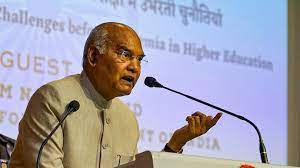
New Delhi, September 23: On Saturday, the high-level committee established under former President Ram Nath Kovind, convened to assess the feasibility of simultaneous elections, held its first meeting to chart its course of action and discuss strategies for engaging with stakeholders.
The government officially formed the eight-member “high-level” panel on September 2, with the objective of examining and expeditiously offering recommendations on the possibility of holding concurrent elections for the Lok Sabha (House of the People), state assemblies, municipalities, and panchayats.
The meeting, described as an introductory session, was convened to discuss the roadmap for fulfilling the panel’s mandate. It included discussions on the preparation of working papers, strategies for consultations with stakeholders, and in-depth research on the subject.
Key members of the committee include Home Minister Amit Shah, former Leader of the Opposition in the Rajya Sabha Ghulam Nabi Azad, and former Finance Commission Chairman N K Singh. While Congress’s leader in the Lok Sabha, Adhir Ranjan Chowdhury, was initially a member, he later declined to participate in the panel, expressing skepticism about its conclusions.
The government’s notification stated that the panel would begin functioning immediately and provide recommendations “at the earliest,” without specifying a deadline for submitting its report.
The decision to establish a committee under former President Kovind took opposition blocs by surprise, and it ignited a political debate. The opposition alliance, holding its conclave in Mumbai on September 1, criticized the move as a “threat” to India’s federal structure.
The committee also includes former Lok Sabha Secretary General Subhash C Kashyap, senior advocate Harish Salve, and former Chief Vigilance Commissioner Sanjay Kothari. Law Minister Arjun Ram Meghwal will attend committee meetings as a special invitee, while Law Secretary Niten Chandra will serve as the panel’s secretary.
The committee’s scope of work encompasses examining and recommending specific constitutional amendments, amendments to the Representation of the People Act, and any other legislative changes necessary for conducting simultaneous elections. It will also suggest a framework for synchronizing elections and provide a timeline for simultaneous elections if they cannot be held all at once. Additionally, the committee will assess whether constitutional amendments require ratification by state assemblies.
The panel is also tasked with proposing solutions for scenarios such as a hung parliament, the passage of a no-confidence motion, defection, or similar events in the context of simultaneous elections. It will also recommend safeguards to ensure the continuity of the simultaneous elections cycle.
Logistical considerations, such as the need for additional electronic voting machines (EVMs), paper-trail machines, and polling and security personnel, are part of the committee’s agenda. It will also examine and recommend the modalities of using a single electoral roll and electoral identity cards for all elections, including those for the Lok Sabha, state legislatures, municipalities, and panchayats.
The original proposal for simultaneous elections aimed to synchronize elections at all three tiers of democracy: Lok Sabha (543 MPs), Vidhan Sabha (4,120 MLAs), and panchayats and municipalities (30 lakh members). The notification cited the historical practice of holding simultaneous elections to the Lok Sabha and legislative assemblies from 1951-52 to 1967 before the cycle was disrupted, resulting in frequent and staggered elections. These frequent elections not only incurred substantial government expenses but also diverted security forces and electoral officers from their primary duties for extended periods. The panel’s mandate seeks to address these issues.


