
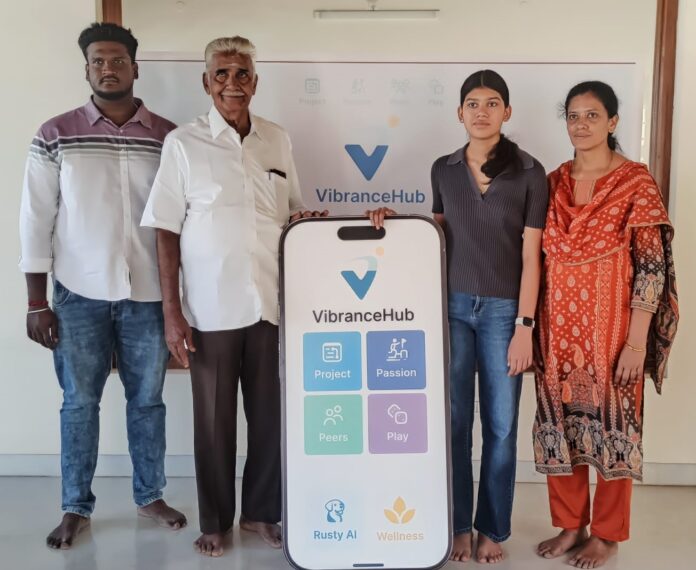
COIMBATORE — Rithanya Sivaram, a Class 12 student at The Indian Public School, has launched Vibrance Hub, a groundbreaking platform designed to enhance project-based learning, peer collaboration, and wellbeing support. This innovative venture addresses a critical gap as India prepares its students for an AI-driven future where creativity, sustained innovation, and practical skills take precedence over rote memorization.
“In the age of AI, information is commoditized. What matters now is what you can make, how you think, and whether you can sustain creative work over time,” explained Sivaram. She emphasized that while the Atal Tinkering Labs provide the necessary tools and spaces for students to explore, Vibrance Hub complements this by offering scaffolding, community support, and integrated wellbeing practices.
Rooted in MIT’s Lifelong Kindergarten framework, which focuses on Passion, Projects, Peers, and Play, Vibrance Hub champions the idea that maker education transcends simple construction activities. It aims to cultivate computational thinking, resilience through iteration, and collaborative abilities—qualities that no AI can replicate.
Vibrance Hub reflects a significant shift towards reviving India’s educational heritage. Before the imposition of a rote-learning system with Macaulay’s Minute on Education in February 1835, India’s traditional gurukul system emphasized experiential learning. Students actively engaged in creating and problem-solving, whether it was learning metallurgy through forging or practicing medicine hands-on.
The National Education Policy 2020 explicitly advocates for rekindling this maker-centric approach. It recognizes that India’s future prosperity hinges on nurturing creators and innovators rather than mere information repeaters.
The Atal Innovation Mission (AIM), launched in 2016 by NITI Aayog, represents India’s most ambitious effort to facilitate this maker-centric philosophy at scale. AIM addresses the NEP 2020’s directive to foster creativity and innovation by establishing tangible infrastructures for hands-on learning across the nation.
The launch of Vibrance Hub aligns well with the evolving educational landscape in India. It aims to equip students with the skills necessary to thrive in a world increasingly dominated by AI and automation. Sivaram envisions this platform empowering students to transition their interests into sustained projects, fostering a culture of innovation and wellbeing.
Experts also laud the initiative as a step towards ensuring that education in India prepares students for contemporary challenges. “By merging creativity with wellbeing, Vibrance Hub has the potential to create a balanced approach to learning,” said Dr. Geeta Ramakrishnan, an educational consultant specializing in innovative teaching strategies.
As students like Rithanya Sivaram take the initiative to shape their educational journeys, the implications of these innovations extend beyond individual growth. A collective movement towards a more practical, hands-on style of learning appears imminent, reinforcing India’s reputation as a hub of creativity and innovation.
Moving forward, Vibrance Hub aims to expand its outreach, inviting students from various backgrounds to join its community. As more learners engage in project-based education rooted in wellbeing, the ripple effects on India’s educational paradigm could prove transformative.


